
Redistricting Tracker: What Changed in 2025 and 2026
Key Takeaways
- This is a break from precedent. Of the 40 mid-decade congressional redraws Pew Research Center counted from 1970 through August 2025, 36 were ordered or imposed by courts. Before 2025, only two states had redrawn voluntarily for partisan advantage. Since summer 2025, ten states have adopted new congressional maps outside the normal cycle.
- Eight new maps are in force for November 2026. Missouri’s is not: on September 25 the U.S. Supreme Court ruled that the state’s 2022 map governs this election, and the 2025 map goes to voters as Proposition A on November 3. Virginia’s map never took effect, because the constitutional amendment it depended on was struck down on procedural grounds
- In force doesn’t mean settled. Of the eight maps in use, only Ohio’s faces no live legal challenge. In Texas, California, North Carolina, Florida and Tennessee, the merits have not been decided, and litigation over Utah’s and Louisiana’s maps is still live.
- Lines can change without anyone adopting a map. Alabama will vote under different districts than in 2024, and no legislature, commission, court or ballot measure adopted them for 2026: a U.S. Supreme Court stay restored the map its legislature passed in 2023.
- This isn’t a one-party story. A Republican Indiana Senate rejected a Republican map, Colorado’s supreme court blocked a Democratic-backed effort, and Colorado and Maryland have ballot measures on November 3 that point in opposite directions.
- District-level data may no longer line up over time. For anyone doing needs assessments, grant reporting or trend analysis by congressional district, mid-decade changes can break a time series even when nothing changed on the ground.
Last updated: SEPTEMBER 2026 · Maintained by PolicyMap · We update this page as maps and court decisions change.
Most redistricting coverage asks which party gains; we’re asking what happens to the data. For the health systems, foundations, community development organizations, and federal grantees that work by congressional district, mid-decade redraws can make district numbers incomparable to their own history. Part three of a three-part series on redistricting. Start with what gerrymandering is and how it works, or read about what can be done about it.
Congressional maps are normally redrawn once a decade, after the census. Mid-decade changes did happen, but almost all of them were ordered or imposed by courts: of the 40 that Pew Research Center counted from 1970 through August 2025, 36 were. Before 2025, only two states had redrawn voluntarily for partisan advantage: Texas in 2003 and Georgia in 2005.
Since the summer of 2025, ten states have moved to redraw their congressional maps outside the normal cycle, and eight of the resulting maps are in force for the November 2026 election. Two are not: Missouri’s is blocked pending a referendum (confirmed for November by the U.S. Supreme Court on September 25, 2026) and Virginia’s never took effect, because the state supreme court struck down the constitutional amendment it depended on.
One more state, Alabama, will vote under different congressional lines than it used in 2024 without having adopted a new map at all. That case gets its own section below, because it is the clearest illustration of what this page is for.
This page tracks what changed, where, and what is still in play. We will maintain it rather than publishing it once, because the situation has changed several times since we started following it — and because a snapshot of this subject is wrong within weeks.
What we count
A state appears on this page if, outside the normal post-census cycle, it adopted new congressional district boundaries, by legislature, commission, court order, or ballot measure, whether or not the map survived to be used. We note the mechanism in each entry, because the mechanism determines what can undo it.
That rule admits Missouri and Virginia, which both enacted maps that will not be used in 2026. It excludes Alabama, which adopted nothing. Yet Alabama’s lines changed for 2026 anyway, which is why it has a section of its own below.
We do not score maps for partisan advantage or project seat counts. Other organizations do that well, and we link to them. We track what the boundaries are, when they changed, and what is still in play. Those three things determine whether district-level data can be compared over time.
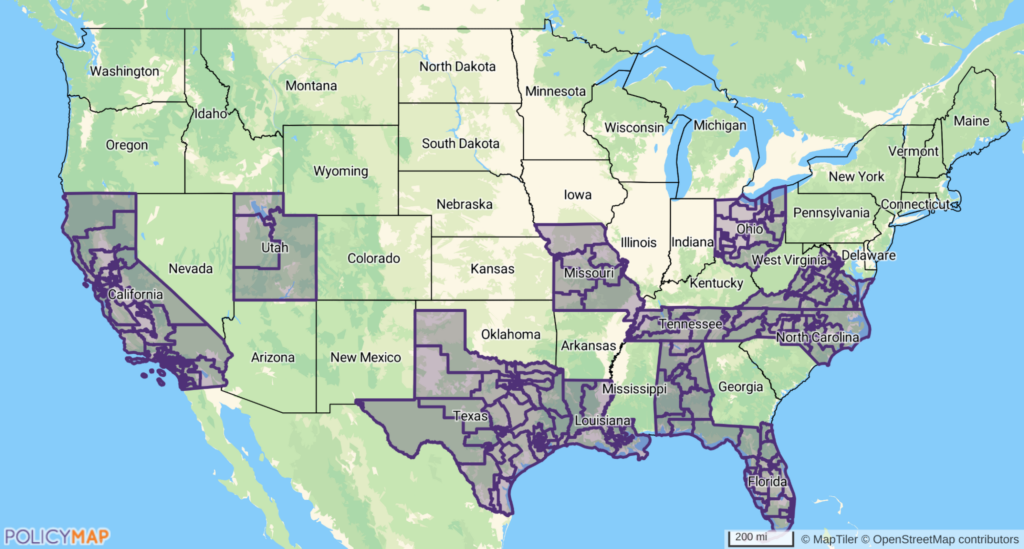
Credit: Map: PolicyMap. New district lines: the state-published plans listed on this page; Alabama: Alabama Legislature, Livingston Congressional Plan 3-2023 (boundary file: Alabama GeoHub); all other states, including Missouri and Virginia: U.S. Census Bureau, 119th Congress districts.
Summary
| State | Mechanism | Adopted | Status as of September 25, 2026 |
|---|---|---|---|
| Texas | Legislature, special session | Aug 29, 2025 | In effect for 2026; merits undecided |
| Missouri | Legislature, special session | Sep 28, 2025 | Blocked — Proposition A on the November 3 ballot; 2022 map governs November. Eighth Circuit ordered the 2025 map Sep 21; U.S. Supreme Court blocked that order Sep 25, 2026 |
| North Carolina | Legislature | Oct 22, 2025 | In effect; merits undecided |
| Ohio | Redistricting commission | Oct 31, 2025 | In effect; locked until 2032 |
| California | Ballot measure (Prop 50) | Nov 4, 2025 | In effect; merits undecided |
| Utah | Court order | Nov 10, 2025 | In effect for 2026; litigation continues |
| Virginia | Legislature, map contingent on a constitutional amendment | Feb 2026 (map); Apr 21, 2026 (amendment) | Struck down May 8, 2026 — amendment voided, so the map never took effect; the court-drawn 2021 map stands |
| Florida | Legislature, special session | May 4, 2026 | In effect; under legal challenge |
| Tennessee | Legislature, special session | May 7, 2026 | In effect; under legal challenge |
| Louisiana | Legislature | May 29, 2026 | In effect — post-Callais; under legal challenge |
Ten states, eight maps in force, counted against All About Redistricting (Loyola Law School) and re-verified September 22, 2026.
The organizations that publish a count do not agree with us, because they are not counting the same thing:
- This page counts states that, outside the normal cycle, adopted new congressional boundaries, whether or not they took effect. That is ten, counted against Loyola Law School’s All About Redistricting.
- NCSL and Ballotpedia both count states with new maps rather than states that acted, and both arrive at ten by a different route: Alabama, California, Florida, Louisiana, Missouri, North Carolina, Ohio, Tennessee, Texas and Utah — Alabama in, Virginia out. Ballotpedia files Alabama separately, as a state that “returned to a previous congressional map after injunctions against it were lifted.” (Both checked September 22, 2026.) We do not count Alabama, for the reason given in “Changed without an adoption” below.
This page turns on one question: whether Alabama belongs on a list like this. The same question applies to Missouri, which adopted a map that will not be used, and to Virginia, whose map never took effect.
The states that redrew
Texas. The legislature redrew Texas’s congressional map in a summer 2025 special session, following a public request from President Trump. A federal district court found the map divided Black and Latino neighborhoods impermissibly; on April 27, 2026, the U.S. Supreme Court summarily reversed that decision 6–3, with Justices Sotomayor, Kagan, and Jackson dissenting. The map governs the 2026 election. The underlying case has not been decided on the merits — that was a reversal of a preliminary injunction, and as of September 2026 the court has yet to rule on the 2021 map, which was tried in 2025, and the 2025 map has not been tried. Texas is the map that started the sequence; most of what follows on this page is downstream of it.
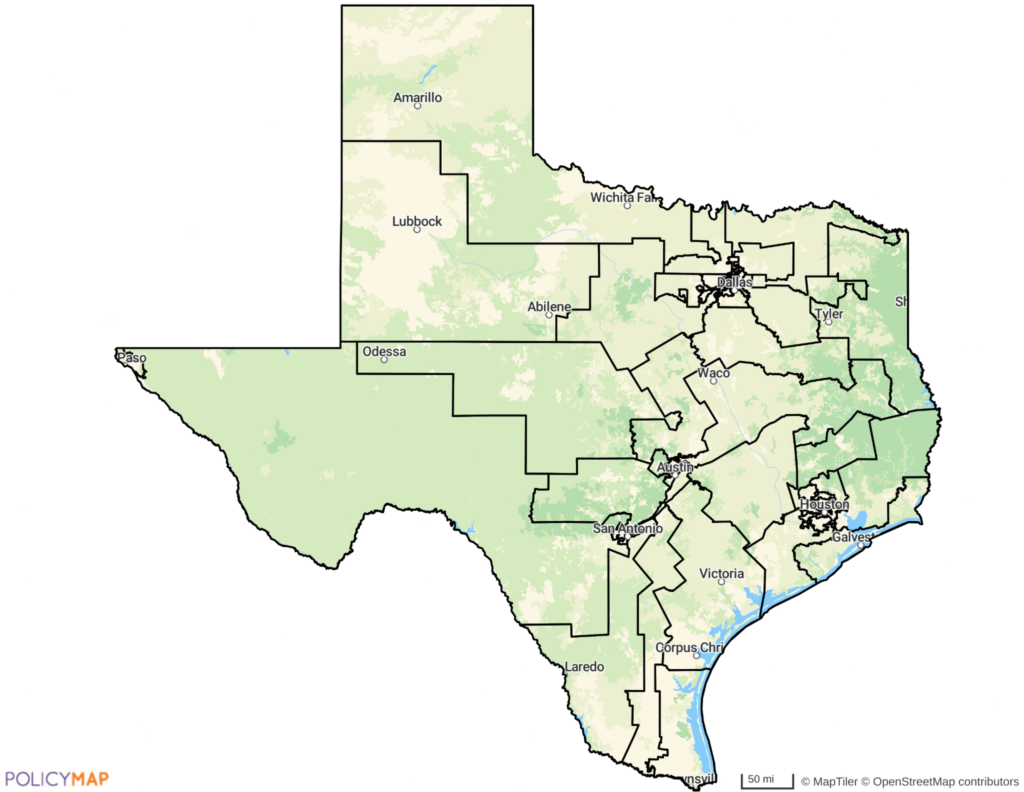
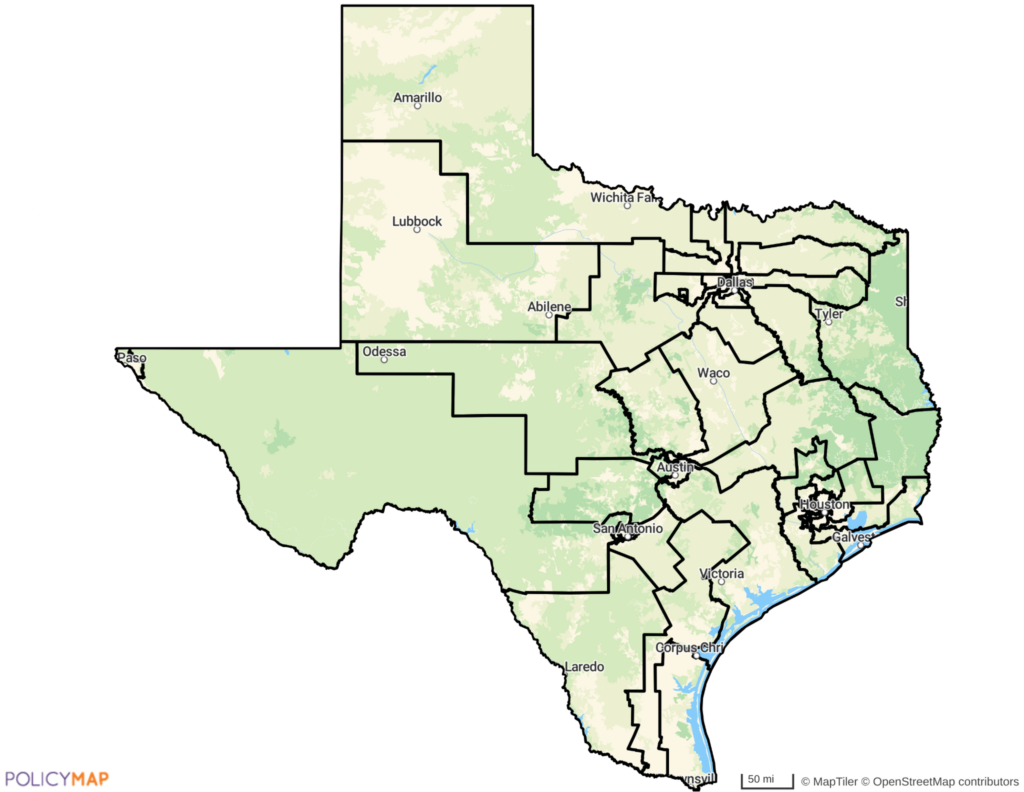
Credit: Map: PolicyMap. Current boundaries: Texas Legislative Council, Plan C2333 (89th Legislature, 2nd Called Session). 2024 boundaries: U.S. Census Bureau, 119th Congress districts.
California. California voters approved Proposition 50 in November 2025, adopting a new congressional map explicitly framed as a response to Texas. Because California’s districts are normally drawn by an independent commission, the measure required a statewide vote to set that process aside for this cycle. A three-judge federal panel denied a preliminary injunction on January 14, 2026. On February 4, 2026, the U.S. Supreme Court denied an application for an injunction pending appeal in Tangipa v. Newsom, No. 25A839 — Justice Kagan referred the application to the full Court, which denied it. That was not a denial of review, and the case is not over: Noyes v. Newsom was consolidated into it on March 17, 2026, motions to dismiss were argued on August 19, 2026 and remain undecided, and Tangipa is pending as of September 25, 2026. The map governs 2026. As in Texas, the merits have not been decided.
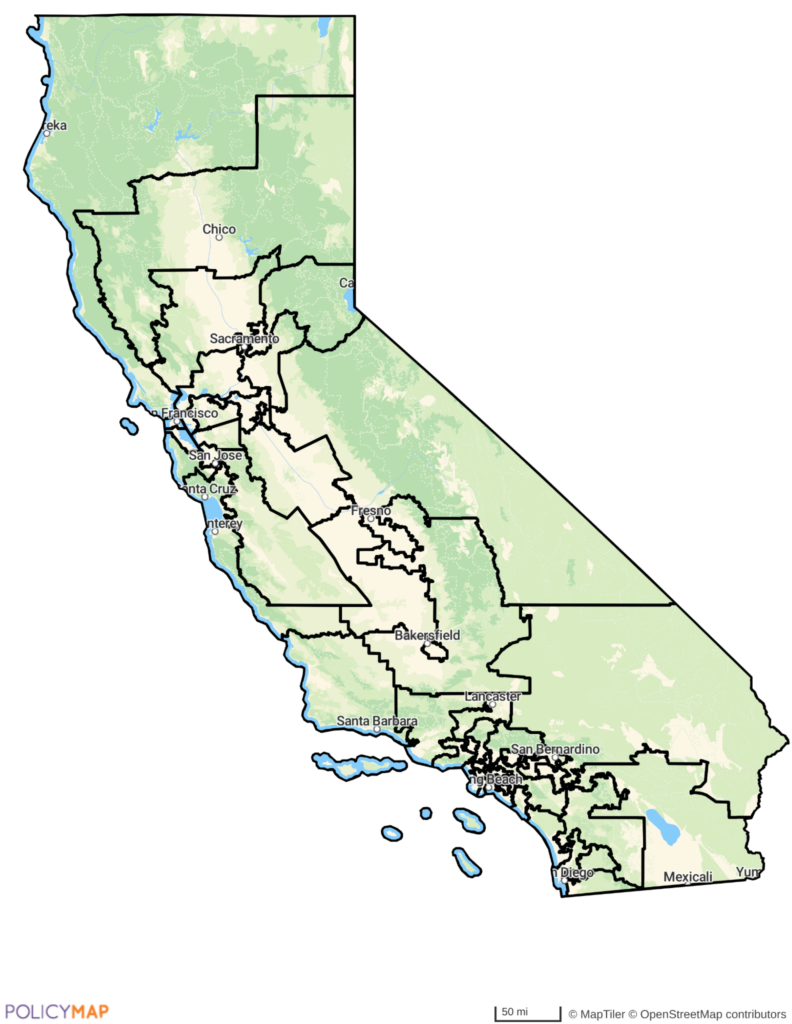
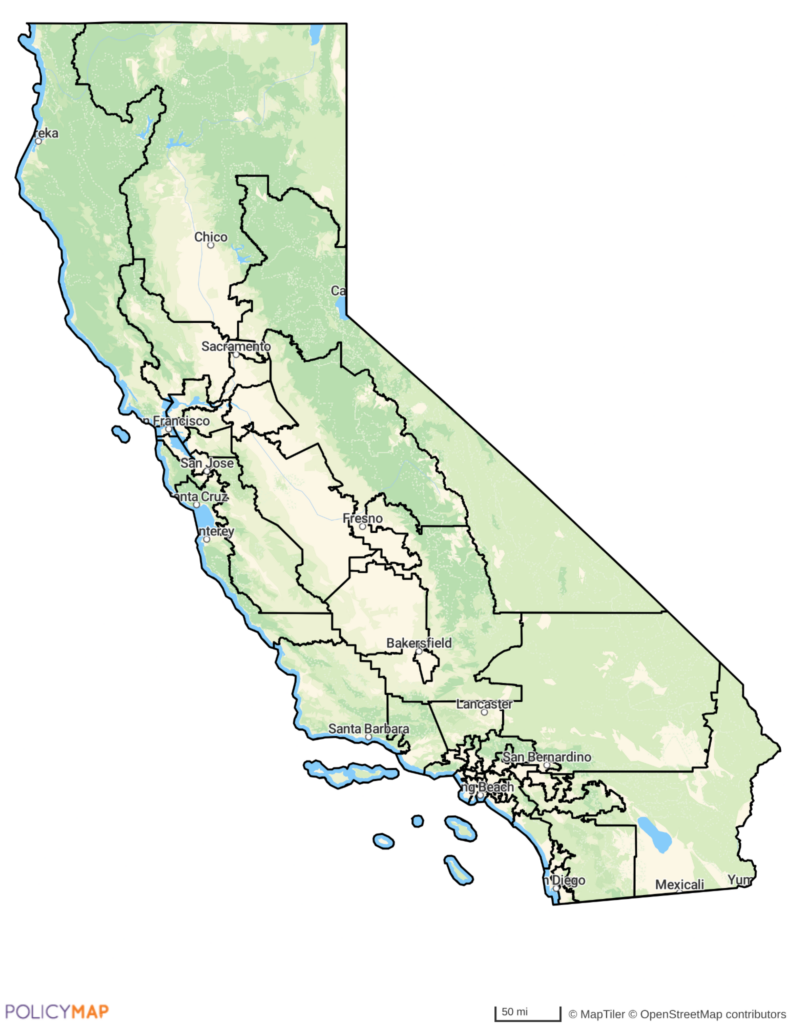
Credit: Map: PolicyMap. Current boundaries: California AB 604 (Proposition 50); boundary file: Statewide Database, UC Berkeley. 2024 boundaries: U.S. Census Bureau, 119th Congress districts.
Missouri. In a September 2025 special session, the legislature enacted a new map that divides Kansas City across districts and substantially changes the 5th District. Governor Kehoe signed it.
The map has been contested ever since. A citizen group gathered more than 300,000 signatures to put it to a veto referendum. The Secretary of State refused to certify the petition, on the ground that congressional redistricting plans are not subject to referendum at all, and a Cole County judge agreed. Missouri’s August 4, 2026 primary was run on the 2025 map — a fact that is still doing work in the arguments being made now.
On September 3, 2026, the Missouri Supreme Court reversed, unanimously. The referendum petition was “legal, sufficient, and timely,” the court held, and the constitutional provision allowing a referendum on “any act” of the legislature reaches congressional redistricting. The new map is blocked for November, the 2026 election runs on the prior lines, and the question goes to voters as Proposition A on November 3, 2026 — the first time a Missouri congressional plan has faced a statewide vote since 1922. A yes vote approves the 2025 map; a no vote keeps the 2022 lines.
Then it moved twice more in a week. The state appealed, and on September 8, 2026 Justice Kavanaugh, acting as circuit justice for the Eighth Circuit, declined to disturb the state ruling; he did not refer the application to the full Court and gave no reasons. Within hours a federal trial court blocked the 2022 map, which would have forced the new lines back into use. The referendum’s sponsors applied to the Supreme Court after the Eighth Circuit refused to pause that order, and on September 10, 2026 the full Court granted a stay — unsigned, no noted dissents. November 2026 runs on the 2022 map.
It did not end there. The Eighth Circuit heard the appeal of that trial-court order on September 17, 2026, with Secretary of State Denny Hoskins asking it also to strike Proposition A from the ballot. On September 21, 2026, a divided panel ruled 2–1 that using the 2022 map in November, after the August primary ran on the 2025 map, violates Article I, Section 2 of the Constitution, which requires “continuity in the constituency throughout all stages of a single election.” It told the trial court to enter a permanent injunction requiring the 2025 map. It did not strike Proposition A, which stays on the ballot, and it kept that order from taking effect until 5 p.m. Central on September 28 so the Supreme Court could review it. The referendum’s sponsors applied on September 22 (No. 26A388), and briefing closed September 23. The dissenting judge would have dismissed the appeal for lack of standing.
On September 25, 2026, the U.S. Supreme Court granted the stay, in an unsigned opinion with no public dissents. It told the lower courts not to block the 2022 map and not to require the 2025 map for this election, because the election “has already started” and a switch “would usher in electoral chaos.” November 2026 runs on the 2022 map, the lines on which ballots for military and overseas voters went out September 18 and absentee voting opened September 22. Proposition A stays on the November 3 ballot and decides the 2025 map’s future.
Four changes of status in eight days, a ruling that would have made a fifth, and a third trip to the Supreme Court that undid it. None of it was an act of the legislature. Beyond Missouri, the question the referendum raises is open in every other state with a citizen referendum process: whether voters can overturn a congressional map at all.
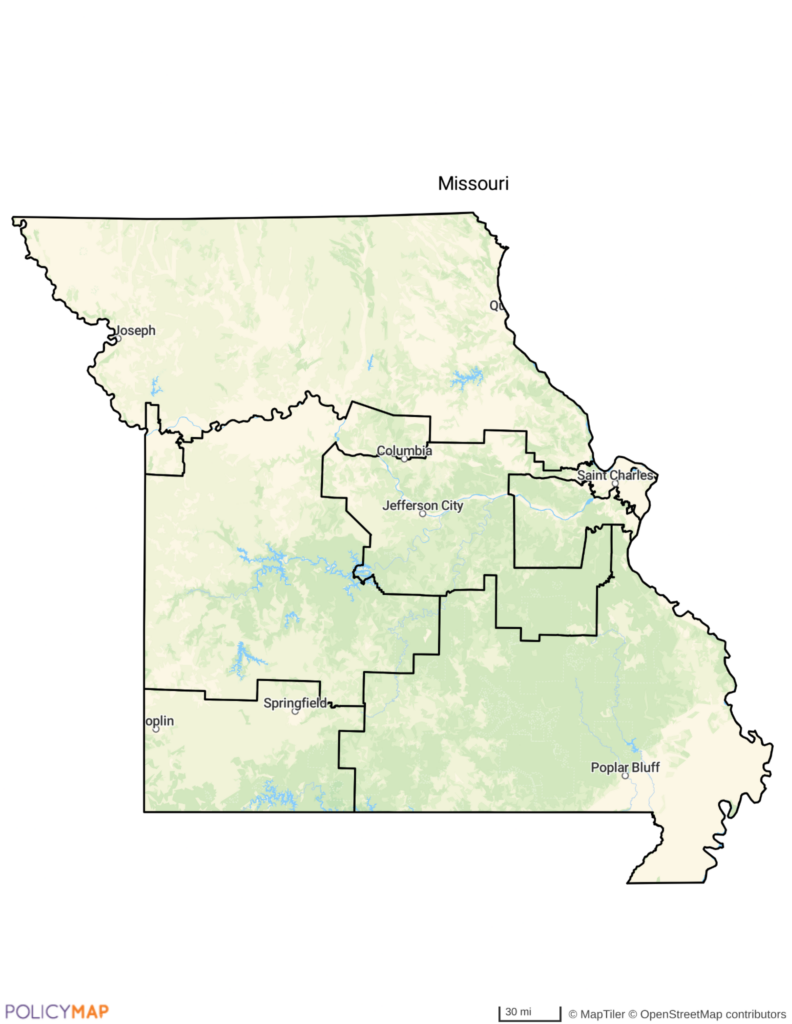
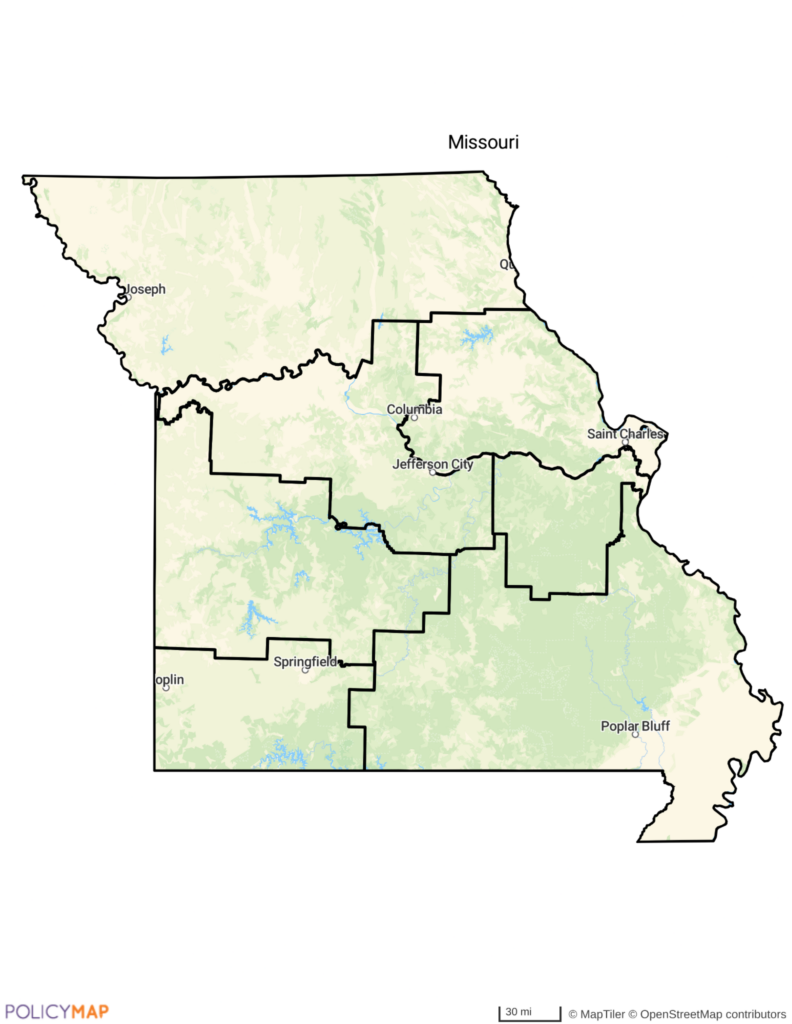
Credit: Map: PolicyMap. 2025 boundaries: Missouri Office of Administration / MSDIS, HB 1 (103rd General Assembly, 2nd Extraordinary Session). 2024 boundaries: U.S. Census Bureau, 119th Congress districts.
Ohio. The Ohio Redistricting Commission unanimously approved a new congressional map on October 31, 2025, redrawing boundaries in the Cincinnati, Toledo and Akron areas. The map is locked in until 2032. Ohio is a useful case for anyone assuming commissions are a structural fix on their own: a commission produced it, unanimously, and it governs the rest of the decade.
North Carolina. The legislature enacted new congressional boundaries on October 22, 2025, reconfiguring the two eastern districts, the 1st and the 3rd. On November 26, 2025, a unanimous three-judge federal panel denied the requested preliminary injunctions in Williams v. Hall, finding that the challengers, the North Carolina NAACP, Common Cause and individual voters, had presented no direct evidence that the legislature acted with racially discriminatory purpose; those plaintiffs voluntarily dismissed their remaining claims on January 16, 2026. A separate suit, Gallop v. Hirsch, filed February 25, 2026 in the Eastern District of North Carolina, is pending as of September 25, 2026: a magistrate judge recommended dismissing it in July, and the district judge has not ruled. The map governs 2026. As in Texas and California, the merits have not been decided. Three of the largest changes on this page are in force with their underlying claims still undecided.
Utah. Utah’s is the one map on this list drawn by a court, and the sequence runs opposite to everything else here. Voters created an independent redistricting commission by initiative in 2018 (Proposition 4); the legislature effectively neutered it and drew its own map. On August 25, 2025, a state trial court held that repealing an unconstitutional abrogation of the people’s right to reform their government restored Proposition 4, and struck the legislature’s map. On November 10, 2025, the court adopted a challenger’s map for 2026. The state supreme court declined to hear the appeal on February 20, 2026 (on jurisdictional grounds, because the trial court has not entered final judgment), and an initiative to repeal Proposition 4 failed to gather enough signatures to reach the ballot by April 30, 2026. A three-judge federal panel declined to overturn the court-selected map on February 23, 2026.
The map governs 2026. It is not settled beyond that, and Utah is the one row on this page where the fight is now over the courts themselves rather than the lines. In February 2026, the legislature passed HB 392, letting government litigants move a pending case out of a single district judge’s hands and into a new three-judge trial court, and then HB 366, which stands up a separate “Constitutional Court” if the first panel is held unconstitutional. League of Women Voters of Utah v. Utah State Legislature is still live, including on the question of whether that new court may lawfully hear it; the Utah Supreme Court has set argument on that question for October 5, 2026.
Florida. Governor DeSantis convened a special session on congressional redistricting; the legislature passed revised maps, and the governor signed them. The maps are challenged in Equal Ground Education Fund v. Byrd, Leon County Circuit Court No. 2026 CA 000914, where the trial court denied a preliminary injunction on May 26, 2026. The Florida Supreme Court declined to take the case on June 10, 2026, 6–1, for lack of jurisdiction, and the challengers withdrew their appeal at the First District Court of Appeal. The case is headed for a bench trial in Leon County, with no trial date set as of September 25, 2026. Florida’s congressional primary was held August 18, 2026, under the new lines.
Tennessee. Governor Lee convened a special session in May 2026, after the Supreme Court’s decision in Louisiana v. Callais, and the legislature enacted a map redrawing the Memphis-based 9th District — the state’s only majority-Black congressional district. Two federal challenges are pending as of September 25, 2026 in the Middle District of Tennessee: TN NAACP v. Hargett (3:26-cv-00638) and Sherman v. Hargett (3:26-cv-00616). A three-judge panel denied a preliminary injunction in Sherman on July 23, 2026, finding that politics rather than race drove the map; the merits of both remain undecided. A third, Hale v. Lee, was voluntarily dismissed on June 9, 2026. Tennessee is the clearest example on this page of a redraw made possible by Callais specifically.
Louisiana. The legislature enacted a new congressional map, Senate Bill 121, on May 29, 2026, drawn in the aftermath of Louisiana v. Callais, the case that began with this state’s map and ended by leaving Section 2 of the Voting Rights Act largely inoperative. The new map eliminates one of the state’s two majority-Black districts. The one challenge we can confirm by name is in Callais v. Landry itself, back before the three-judge federal court in the Western District of Louisiana, which set a hearing on SB 121 for June 17, 2026, then cancelled it, and has not ruled as of September 25, 2026. Along with Tennessee, this is what Callais looks like as lines on the ground rather than as doctrine.
Adopted and then undone
Virginia belongs in neither list cleanly, which is why it gets its own heading. Virginia’s constitution gives congressional map-drawing to a bipartisan commission; when that commission deadlocked in 2021, the state supreme court drew the map in use today. In February 2026 the legislature enacted a new congressional map that would take effect only if voters approved a constitutional amendment taking the power back for the rest of the decade, and on April 21 the amendment passed. On May 8, 2026, the Virginia Supreme Court struck it down, 4–3 — not on the merits of mid-decade redistricting, but on the ground that the amendment had not been passed in two properly separated legislative sessions, as the state constitution requires. That voided the map before it took effect. The U.S. Supreme Court declined to intervene on May 15, 2026. The ruling does not stop Virginia from trying again by the proper sequence, but not in time for 2026, and the court-drawn 2021 map stays in use.
Virginia is the cleanest illustration of the mechanism column doing real work: a map that depends on a constitutional amendment can be undone, before a single election is run on it, by a procedural defect in how the amendment was passed, which is not a risk any of the other mechanisms on this page carry.
Changed without an adoption
Alabama is the one state on this page whose congressional lines changed for 2026 without anyone adopting a new map.
The legislature passed its current map on July 21, 2023. A federal court blocked that map under Section 2 of the Voting Rights Act in 2023, and the 2024 election ran on a court-drawn plan with a second district where Black voters had an opportunity to elect a candidate of their choice; in May 2025, after trial, the court went further and found the 2023 map intentionally discriminatory against Black voters. On May 26, 2026, the three-judge district court reiterated that finding and enjoined the 2023 map again. On June 2, 2026, the U.S. Supreme Court stayed that injunction, which restored the 2023 map for the 2026 election. The appeals are docketed at the Supreme Court as Allen v. Milligan, No. 26-117, and Allen v. Singleton, No. 26-118, with jurisdictional statements filed July 22, 2026. The Alabama voters responded on September 18; in Milligan with a motion to dismiss or affirm, in Singleton with a motion to dismiss; neither had been scheduled for conference as of September 25, 2026.
No legislature, commission, court-drawn plan or ballot measure produced Alabama’s 2026 boundaries. A stay did, yet Alabama voters will still choose their representatives under different lines than they used two years ago.
This is the whole argument of this series in a single state. Uninsured rates, poverty, grant reporting, a needs assessment: anyone tracking an Alabama district across 2024 and 2026 has a broken time series, and no enactment anywhere to point at as the moment it broke. The container changed while nothing was adopted.
Where the lines could still move
Georgia’s congressional map is subject to change through litigation that predates this whole sequence. Pendergrass v. Raffensperger, No. 1:21-cv-05339 (N.D. Ga.), a Voting Rights Act challenge to the state’s congressional districts, went back to the trial court on August 25, 2026, when the Eleventh Circuit vacated its 2023 liability ruling and remanded for reconsideration under Callais. Georgia’s 2026 elections are unaffected; its 2028 map may not be. Georgia separately considered a mid-decade redraw of its own and did not carry it out; that is in the next section.
Georgia is not the only place the lines could still move. Of the eight in-force maps, only Ohio’s faces no live challenge. In Texas, California, North Carolina, Florida and Tennessee the merits have not been decided, and Utah’s and Louisiana’s litigation is still live; each is covered in its own entry above. A map being used in November is not the same thing as a map that has survived a challenge.
Mississippi has adopted nothing, but it is the newest state to open the question. After Callais, the legislature’s Joint Legislative Committee on Reapportionment and Redistricting scheduled eight public hearings across the state, running through October 1, 2026, on possible changes to its congressional, legislative and judicial districts. No map had been proposed as of September 25, 2026. We will add Mississippi to the list above if it adopts one.
States that considered redrawing and did not
Eight states had mid-decade redistricting on the table and did not carry it out, and they are worth naming because their absence from the list above was a decision rather than an oversight, and because they fall on both sides.
Indiana. After public pressure from President Trump, including threatened primary challenges against Republican legislators, Governor Braun called a special session in October 2025. The House passed a new map, 57–41. The Senate killed it on December 11, 2025, 31–19, with 21 Republicans joining all 10 Democrats against it — a Republican chamber rejecting a Republican map under direct pressure from the president.
Kansas. An attempt to force a special session by petition failed in November 2025, ten signatures short of the two-thirds required. In January 2026, House Speaker Dan Hawkins declined to bring redistricting legislation to a vote, with Republicans roughly twenty votes short of the 84 an override of Governor Laura Kelly’s expected veto would have required.
Georgia. Governor Kemp called a special session on May 13, 2026, to convene June 17, 2026. Hours before it opened, House Speaker Jon Burns wrote to Kemp that the legislature would not take up redistricting at all, citing a preference for moving slowly while the post-Callais litigation landscape settled. The session was aimed at the 2028 cycle rather than 2026, so Georgia’s maps for this November were never in question.
South Carolina. The effort died in the Senate, twice. On May 12, 2026, a resolution extending the legislative calendar to take up redistricting fell short of the two-thirds it needed, 29–17, with five Republicans joining all twelve Democrats against it. Governor McMaster then called a special session, and the House passed a map on May 20; on May 26, the first day of early voting, the Senate voted to carry the bill over, with twelve Republicans joining the Democrats.
Maryland. The House passed a redistricting bill 99–37 on February 2, 2026. Senate President Bill Ferguson declined to bring it to a vote, citing the state’s exposure to court challenges.
Maryland then took the constitutional route instead. The General Assembly passed a constitutional amendment and Governor Moore signed the enabling legislation; two lower courts struck it from the ballot; and on September 3, 2026 the Maryland Supreme Court reversed and ordered it onto the November 3 ballot as Question 3, directing a rewrite of the ballot summary. The amendment clarifies that the Maryland Constitution’s districting standards, including compactness, apply only to General Assembly districts and not to congressional ones, and it lets the legislature give the Supreme Court of Maryland original jurisdiction over congressional plans. It targets 2028, not 2026.
Illinois. No congressional redistricting bill was formally introduced. Legislative leaders argued a further redraw was not achievable, and Governor Pritzker had tied the state’s willingness to whether Indiana enacted a map — then welcomed Indiana’s rejection of one.
New York. New York had no realistic path of its own: changing the state’s redistricting rules requires a constitutional amendment, which cannot be completed on this timeline. What it had instead was litigation, and that sequence is worth stating precisely, because the two halves are easy to conflate. On January 21, 2026, a state judge held in Williams v. Board of Elections of the State of New York that the 11th District (all of Staten Island and part of southern Brooklyn) diluted Black and Latino voting strength in violation of the state constitution, and ordered the state’s commission to redraw it by February 6. On March 2, 2026, the U.S. Supreme Court stayed that order, 6–3 and unsigned. The petitioners then dismissed their claims with prejudice on March 19, 2026, and the case is closed on agreement of the parties. New York’s congressional map is settled for 2026 and the challenge to the 11th District is finished.
Colorado. On June 29, 2026 the state supreme court, unanimously and in two opinions, blocked five proposed ballot initiatives: three that would have paused the state’s independent commission and allowed a redraw before the 2028 election, and two Republican-backed competing measures. The rulings turned on Colorado’s single-subject requirement rather than on whether mid-decade redistricting is permissible: Chief Justice Monica Márquez wrote that “changing long-settled law by modifying the timing, frequency, criteria, and entity responsible for congressional redistricting represents a significant change beyond the proponents’ stated central purposes,” and that setting the commission aside would be a “seismic shift to Colorado’s longstanding redistricting process enshrined in the state constitution.” The three commission-pausing initiatives were backed by a group linked to House Minority Leader Hakeem Jeffries: a Democratic effort stopped in a Democratic state, and the reason it belongs here rather than left out.
Colorado is also not finished, and the next move comes from the other direction. Amendment 86 — “Require Commission and Supreme Court Approval for Mid-Decade Congressional Redistricting,” filed as Initiative 256 — was certified by the Secretary of State on August 31, 2026 on 141,866 valid signatures against 124,238 required, and goes to voters on November 3. It would require both the independent commission and the state supreme court to approve any mid-decade map before it took effect, and would bar approving a map drawn purposefully to favor one party. It needs 55% to pass and is backed by Advance Colorado, a conservative group.
Colorado’s Amendment 86 and Maryland’s Question 3 sit on the same November 3 ballot and point in opposite directions. Colorado’s would make a mid-decade redraw harder. Maryland’s would make one easier. Between them, they are the clearest evidence on this page that this is not a one-party phenomenon.
States where only the courts were asked
Two states belong on this page but not in the section above, because nothing was ever put to a legislature. In both, the only challenge to the existing lines has run through the courts. In Arkansas it failed; in Wisconsin it is not finished.
Wisconsin. The state supreme court declined to hear Felton v. WEC as an original action in June 2025. Bothfeld v. WEC and WBLD v. WEC were dismissed by three-judge circuit court panels in March and April 2026, and the Wisconsin Supreme Court heard both appeals on September 16, 2026. It has not ruled as of September 25, 2026; the challengers are seeking a new congressional map before 2028.
Arkansas. A three-judge federal panel rejected a challenge to the state’s 2021 map in June 2025, in Christian Ministerial Alliance v. Thurston (now captioned v. Jester), finding insufficient evidence of a racial gerrymander. That case was not about mid-decade redistricting, and should not be read as Arkansas declining to redraw. Arkansas appears on some consolidated lists of unsuccessful mid-decade attempts; we have not found sourcing for one, and the 2021 case is not it.
Why this matters beyond the seat count
Most coverage of these redraws is about which party gains. Our interest is different.
A congressional district is a unit of measurement as well as a political unit. Health systems, community development organizations, foundations, and federal grantees do needs assessments by district, report to funders by district, and brief members by district. When lines move mid-decade, district-level numbers stop being comparable to their own history. Not because anything changed on the ground, but because the container changed.
That is a question we intend to take up in detail separately. When we do, it will be linked here.
Request More Information
Ten states have adopted new congressional maps since 2025, and the lines are still shifting. If your organization reports, plans or briefs by congressional district and needs data that reflects the boundaries that actually apply, fill in the form below. Our sales team will be in touch shortly.